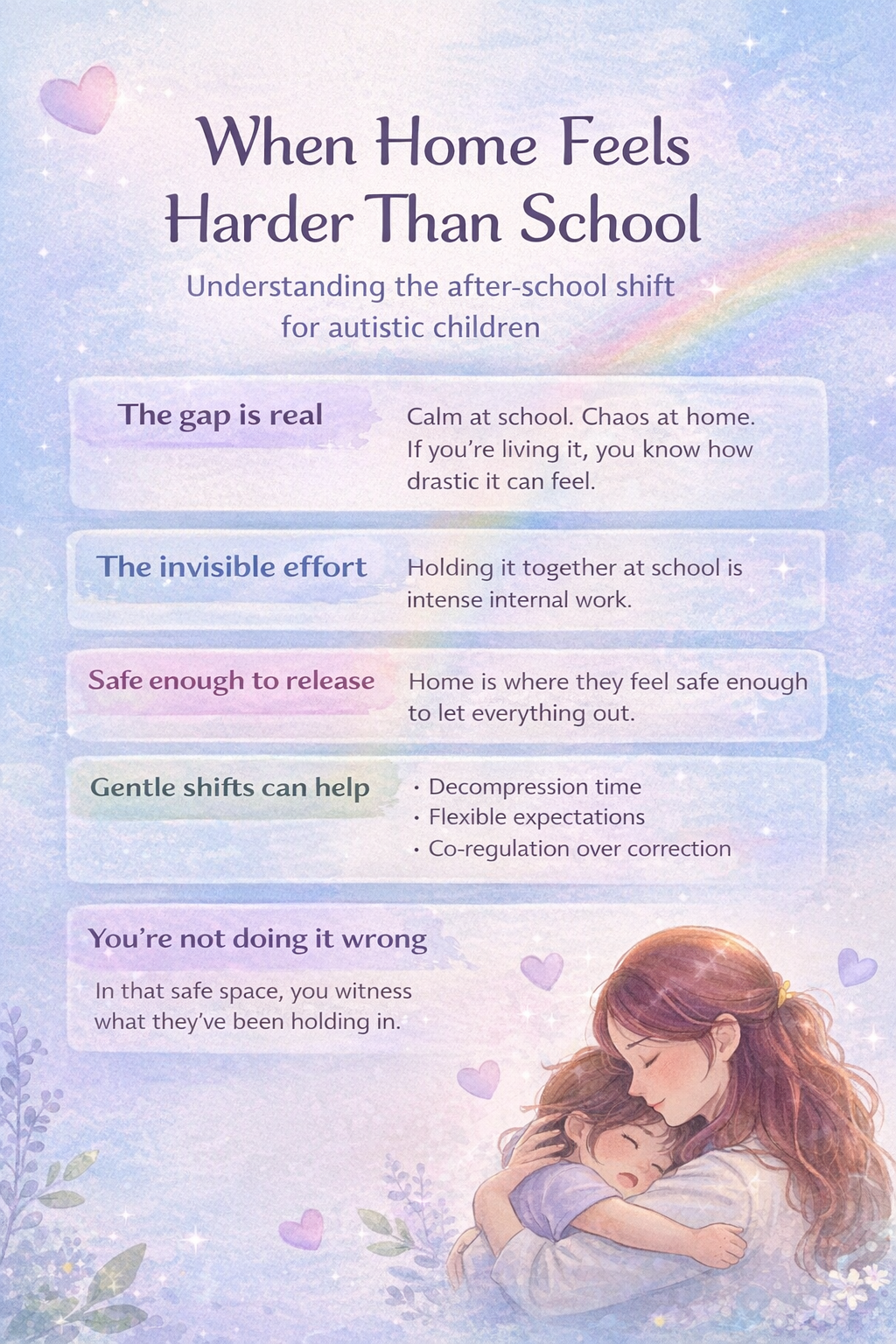
When Home Feels Harder Than School
Understanding why autistic children can appear regulated at school and deeply overwhelmed at home.
There is often a version of a child the outside world sees, and a very different version that comes home.
At school, they may follow routines, participate, and appear calm. At home, everything can spill out through anxiety, aggression, emotional overwhelm, or shutdown.
For parents and caregivers, that contrast can feel confusing, painful, and incredibly frustrating. It can leave you wondering how things can look so manageable in one space and so intense in another.
The difference does not mean your child is “fine” at school and “choosing” to fall apart at home. Often, it means home is the place where the nervous system finally lets go.
The structure at school can feel safer
Many autistic children do benefit from structure. School often provides clear expectations, consistent routines, repeated schedules, visual order, and more predictable transitions. Even when school is exhausting, the structure itself can create a sense of containment.
That does not mean school is easy. It means the environment may be externally organized in a way that helps them hold things together for a while.
“Doing well” can still require enormous effort
A child may seem calm in the classroom while doing a tremendous amount of invisible internal work. They may be masking discomfort, pushing through sensory overload, following rules carefully, monitoring social interactions, and trying to stay in control for hours at a time.
By the time they get home, the emotional and nervous system cost of that effort can finally show up.
Why home can feel so much harder
Home is often the place where safety lives. And safety can look very different from ease.
At home, a child may finally release what they have been holding in all day. That release may not look gentle. It can look like:
- aggression
- heightened anxiety
- irritability
- meltdowns
- tears over small transitions
- an intense need for control
This can be one of the most difficult parts for families, because the people working the hardest to be the safe place often receive the hardest behaviors.
When aggression increases, it is often a nervous system signal
It can be especially distressing when a child seems to be craving aggression, conflict, or chaos. But what looks like a pull toward aggression may actually be a nervous system stuck in a fight-or-flight state.
Aggression is not always about anger in the way adults interpret it. Sometimes it is a stress response. Sometimes it is the body trying to discharge pressure. Sometimes it is what happens when anxiety builds faster than regulation skills can keep up.
That does not make it easy. And it does not mean boundaries do not matter. But it does change how we understand the behavior.
The home-school difference is real
So many parents quietly carry the weight of this question: “Why can my child do it there, but not here?”
The answer is often not that your child is giving their best somewhere else and saving the worst for you on purpose. The answer may be that home is where their system feels safe enough to stop performing, stop holding, and stop bracing.
What looks like regression at home can sometimes be release.
The emotional toll on parents matters too
Being the safe place does not always feel beautiful. Sometimes it feels exhausting, lonely, and defeating.
You can understand why it is happening and still feel overwhelmed by it. You can love your child deeply and still feel frustrated by how drastic the difference is between school and home.
Both things can be true at once.
Gentle shifts that may help
- Build in decompression time after school before demands, homework, or too many questions.
- Keep home routines predictable where you can, especially during after-school hours.
- Lower expectations during high-stress windows and focus on regulation before correction.
- Watch for sensory buildup, transition fatigue, hunger, and emotional overload.
- Stay curious about patterns instead of only reacting to the hardest moments.
A softer way to look at it
When things are drastically different at home, it is easy to assume something is broken. But sometimes what you are seeing is not failure. Sometimes you are seeing trust, overload, and release all tangled together.
That perspective does not erase the difficulty. But it can bring a little more compassion into a dynamic that already asks so much of everyone involved.
If home feels harder right now, you are not imagining it.
If the gap between school and home feels drastic, you are not alone.
And if you are holding the hardest parts of your child’s day, that does not mean you are doing it wrong.
Keep going — but gently. 💜